How do you invest in crypto as a complete beginner?
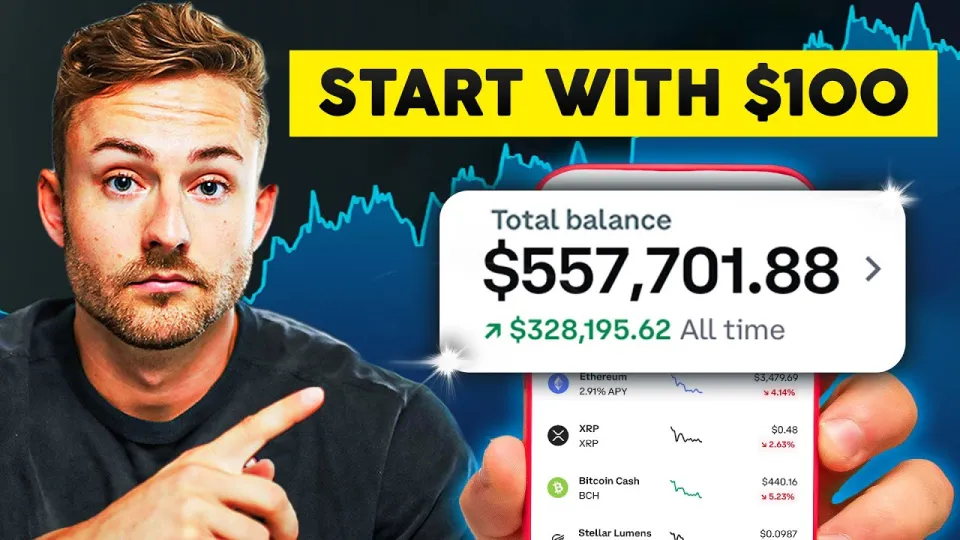
You can order the same kind of articles for your own video to boost it on YouTube and Google. Just message the Telegram bot @sat_sit_bot. The bot writes and publishes the articles itself (with your YouTube video embedded) on popular topical websites (no ads). Your first 50 articles are free.
· based on the channel Craig Percoco
Key takeaways
- Craig Percoco distills seven years of trading and investing into a beginner roadmap covering basics, fundamentals, technicals, execution and organization.
- Crypto is framed as an emerging market with generational-wealth potential, but futures and crypto trading are explicitly high-risk and can exceed the initial investment in losses.
- Beginners should learn for free first via the linked trading resource before paying for courses or private communities.
- A written plan, a journal and position sizing are presented as the difference between the top 1% of investors and everyone else.
- A large share of beginner losses comes from a lack of system, patience, discipline, backtesting, journaling, psychology and risk management.
Investing in crypto as a complete beginner means learning five things in order: what the asset actually is, why it might be worth something, how to read its price chart, how to buy and sell safely, and how to keep records so you can repeat what works. Craig Percoco, who has traded and invested for seven years, packages that path in his beginner guide, which starts with a free trading education resource at the free trading course before any money is put at risk.
What crypto basics a beginner must understand first
Crypto is a market of digital assets recorded on blockchains, and the first job is to separate the network from the token. Bitcoin is the largest and oldest, Ethereum is the second-largest and hosts smart contracts, and thousands of smaller coins, usually called altcoins, compete for attention below them. A beginner does not need to know every project; they need to know what problem the network solves, who pays for its output, and why the token exists at all.
The practical starting set is small. Most newcomers begin with Bitcoin and Ethereum because they have the deepest liquidity, the longest track records and the most transparent information. Everything beyond that is a research project, not a default purchase. The video's framing is that crypto is an emerging market with room for generational wealth, but that framing only holds if the investor can tell a real network from a marketing page.
Why the potential is large and the risk is larger
Crypto markets are young, trade around the clock and move faster than most traditional assets, which is exactly why the upside attracts attention and why the downside punishes carelessness. The same volatility that can multiply a position in a bull run can cut it in half during a correction, and leveraged products such as futures can wipe out more than the money deposited. Craig Percoco's own disclaimer is blunt: futures and crypto trading are highly risky, not for everyone, losses can exceed the initial investment, and only risk capital should be used.
That combination of high potential and high risk sets the beginner's rulebook. Position size comes before conviction, borrowed money stays out of the picture, and any capital committed should be money whose loss would not change your financial security. Treating crypto as a small, speculative slice of a broader portfolio is the difference between participating in an emerging market and gambling on it.
Crypto fundamentals: tokenomics, supply and demand
Fundamentals in crypto start with tokenomics, the rules that govern a token's supply. A beginner should check the maximum supply, the circulating supply, the emission schedule and how new coins enter the market, because a token that inflates quickly needs constant new demand just to hold its price. Bitcoin's fixed cap of 21 million coins and its halving schedule are the classic example of scarcity designed into the code; many altcoins have no such limit.
Beyond supply, look at demand drivers: who uses the network, what fees it generates, how much of the token is held by the founding team and early investors, and whether unlocks are scheduled that could flood the market. Utility matters too, since a token that is required to pay for a service has a reason to be bought. A beginner who can answer these questions in a paragraph has done more homework than most buyers in a bull run.
Crypto technicals: reading a chart without overcomplicating it
Technicals are the study of price and volume, and for a beginner they serve one purpose: deciding when to act rather than guessing. Start with the basics of a candlestick chart, support and resistance levels, and trend direction on a higher timeframe such as the daily or weekly. Volume confirms whether a move has participation behind it, and a breakout on thin volume is a common trap.
Indicators are optional, but if they are used, fewer is better. A moving average can show trend, a relative strength measure can show momentum, and that is usually enough for a long-term investor. The most valuable technical habit is backtesting: checking how a rule would have performed on past data before trusting it with real money. Backtesting plus a written entry and exit rule turns chart reading from opinion into a repeatable process.
How beginners actually make money in crypto
There are three realistic ways a beginner makes money, and they are ranked by difficulty. The first is long-term holding of large, liquid assets, buying over time and ignoring short-term noise. The second is swing trading around clearly defined levels with strict stop losses. The third is leveraged trading, which is where most beginners lose their capital and which should not be the starting point.
Making money also depends on behavior rather than prediction. The most frequently cited beginner failures are a lack of a system, a lack of patience, a lack of discipline, no backtesting, no journaling, poor psychology and poor risk management. Each of those is fixable with process. A trader who risks a small fixed percentage per trade, waits for their setup and records every outcome is already ahead of the majority who chase signals and small wins with oversized positions.
How to buy and sell crypto safely
Buying crypto starts with choosing a regulated exchange that supports your country and your bank, completing identity verification, and enabling two-factor authentication before any deposit. Fund the account with a small amount, buy a major asset with a market or limit order, and confirm the fee structure, since spreads and withdrawal fees quietly erode small positions. A limit order lets you set the price you are willing to pay; a market order fills immediately at whatever price is available.
Selling follows the same discipline in reverse. Decide in advance what would make you sell, whether that is a price target, a change in the project's fundamentals, or a rebalancing rule, and write it down before emotions get involved. For larger holdings, moving assets to a self-custody wallet removes exchange counterparty risk, but it also means the seed phrase becomes your entire security perimeter. Never share it and never store it digitally.
How to stay organized as a crypto investor
Organization is the quiet edge in crypto. Keep a simple journal with the date, the asset, the reason for the trade, the position size, the stop level and the outcome, and review it monthly to see which setups actually work. A spreadsheet of holdings with purchase prices and current values makes tax reporting and portfolio rebalancing far easier than reconstructing history from exchange emails.
A written investment plan is the other half. It should state how much of the portfolio crypto may occupy, which assets are allowed, how much is risked per trade, and what conditions would cause a full exit. Craig Percoco's stated goal is to help viewers join the top 1% of investors, and that group is separated less by secret indicators than by documentation, patience and the willingness to follow their own rules when the market is loud.
All resources from the guide
- Free trading education: https://bit.ly/3VHSOeT
- Crypto trading course and private team: https://bit.ly/3xhn47c
- Discord community access: https://bit.ly/3VmrO3r
- All resources: https://bit.ly/3zeM13u
- TradingView charting: https://bit.ly/3Xf9uvz
Final thoughts on starting out in crypto
A beginner can invest in crypto responsibly by learning the basics, checking tokenomics, reading a simple chart, sizing positions so losses stay survivable, buying through a secure exchange and journaling every decision. None of those steps requires predicting the market, and all of them reduce the chance of the classic beginner wipeout. The guide from Craig Percoco is a useful map of that path, and the free starting point is the free trading education resource linked in the video. Start small, document everything, and let the process compound before the position size does.
Source: How To Invest in Crypto as A COMPLETE Beginner [2025 GUIDE] · Markdown version
Questions & answers
How much money do I need to start investing in crypto?
There is no minimum, but the amount should be money you can afford to lose entirely, since crypto is volatile and leveraged products can lose more than the deposit. Many beginners start with a small sum on a major asset such as Bitcoin or Ethereum while they learn the mechanics of buying, storing and selling. Increasing the position size only makes sense after a written plan and a journal exist.
Do I need a mentor or a paid course to trade crypto?
A structured course can shorten the learning curve, but it is not a substitute for practice and record keeping. Free resources, backtesting and a trading journal cover most of the fundamentals a beginner needs. If you do pay for guidance, check whether the teacher shows real, verifiable results rather than hypothetical trades.
Why do most beginners lose money in crypto?
The recurring causes are the absence of a system, impatience, weak discipline, no backtesting, no journaling, poor psychology and poor risk management. Chasing small wins with oversized positions and trading without a stop loss turns normal volatility into account damage. Fixing the process matters more than finding a better signal.
Is crypto investing different from crypto trading?
Investing means holding assets over longer periods based on fundamentals such as supply, adoption and utility, while trading means taking shorter positions based on price action and technical levels. Beginners usually do better starting with the investing approach and a small allocation. Trading, especially with leverage, demands a tested system and strict risk limits.